
Quick Answer
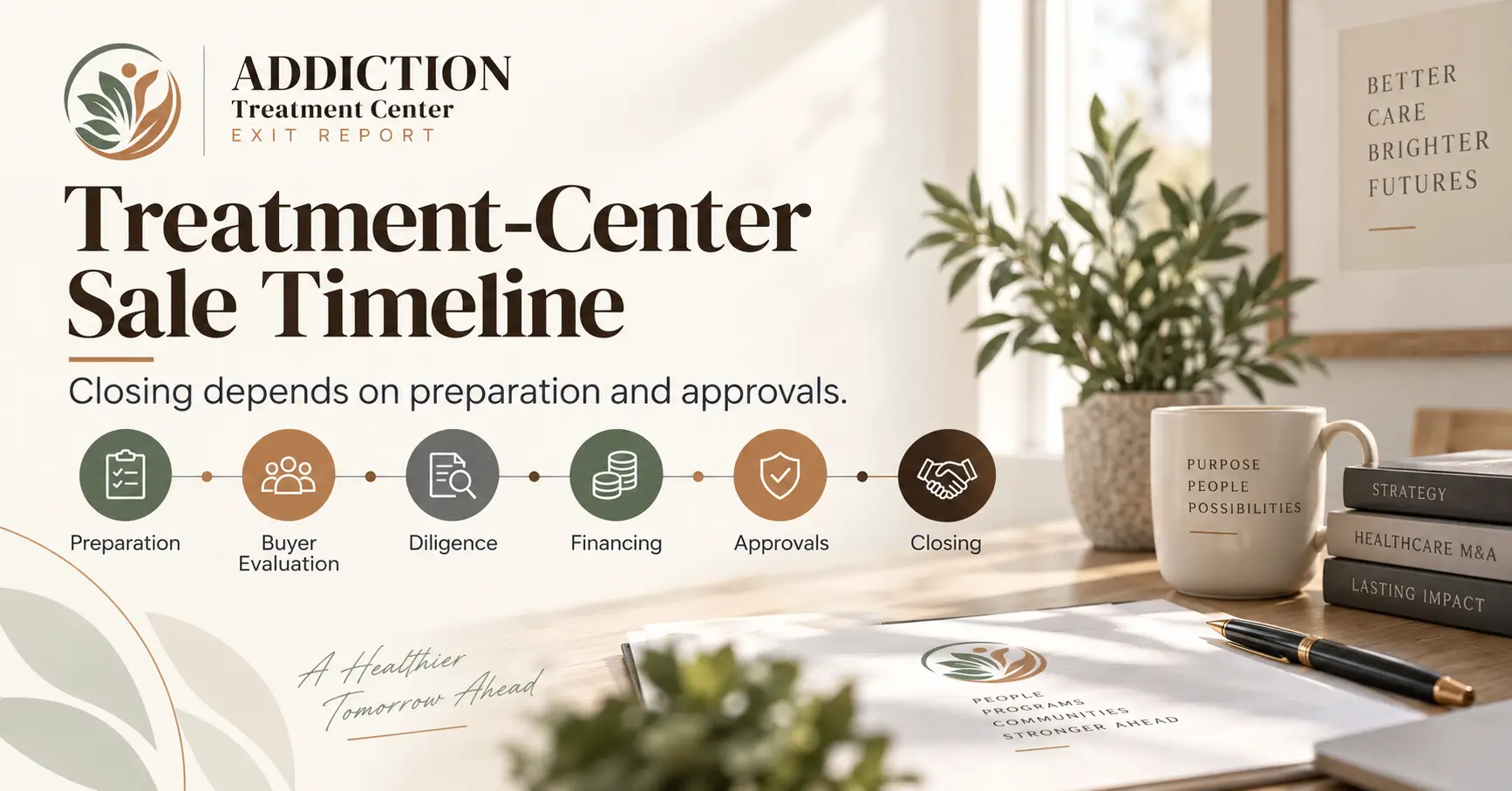
A treatment center sale timeline depends on preparation, buyer decisions, diligence, financing and applicable approvals. Work backward from the conditions needed to close, rather than promising a universal number of months. The most useful schedule names each dependency, responsible person and evidence required before the next stage can proceed.
The closing date is usually the last question to answer
A buyer says it can move quickly. You would like to finish before a lease renewal, a personal milestone or another demanding year. It is tempting to turn that preference into a transaction timetable immediately.
A more useful approach is to ask what must happen before ownership can change responsibly. Financial questions need answers. The parties need agreement on terms. Financing and required approvals may have their own processes. Staff and patients still need continuity while the transaction team works.
This article focuses on the dependencies behind a treatment center sale timeline. The full process sits in Selling an addiction or SUD business: the owner process. Here, the aim is to help an owner build a schedule that can be managed rather than a date that becomes a source of pressure.
Separate preparation time from buyer time
The sale process begins before a buyer receives a presentation. Ownership records, financial reconciliations, service descriptions and the proposed transaction perimeter need to be clear enough for informed discussion. If that work is incomplete, a fast buyer cannot make the missing evidence appear.
Create two schedules. The first covers the seller’s preparation: the documents, decisions and issues within your team’s control. The second covers the transaction once selected buyers are engaged. Keeping them separate helps you see whether a delay reflects your readiness, a buyer dependency or an external requirement.
Avoid treating document collection as the whole preparation phase. An uploaded payer contract still needs review for the relevant questions. A financial report may need reconciliation before it is reliable. Time spent understanding a problem early can be more useful than time spent answering repeated questions about it later.
Set a reasonable internal response process as well. Decide who can answer routine requests, who reviews sensitive material and which questions need professional advice. Without that arrangement, a straightforward request may sit in several inboxes while everyone assumes someone else is handling it.
Build the treatment center sale timeline around decision gates
Use decision gates instead of an attractive sequence of calendar boxes. A gate states what must be true before the next commitment makes sense. For example, buyer outreach may depend on a coherent financial picture and an approved description of what is for sale. Selling an addiction or SUD business: the owner process
An offer-comparison gate may require enough detail on price, payment structure, financing, retained responsibilities and key assumptions. An exclusivity decision may require a clear understanding of the buyer’s diligence plan and unresolved conditions. Closing requires the actual conditions in the transaction documents to be satisfied or dealt with as agreed.
For each gate, identify evidence and an accountable person. Do not mark financing ready because the buyer says it is confident. Ask what evidence is appropriate for the transaction and what remains conditional. Do not mark an approval ready merely because an application has been submitted.
This approach makes uncertainty visible without making the process unmanageable. A schedule can still have target dates, but those dates sit beside their assumptions. When an assumption changes, the team can update the plan deliberately.
Understand where buyer selection consumes time
Not every serious buyer will review the opportunity at the same pace. Internal approvals, diligence resources, financing choices and competing priorities can affect responsiveness. A quick expression of interest is not the same as an executable offer.
Agree on a request format that makes offers comparable. Ask buyers to distinguish closing cash, deferred consideration, retained equity, financing conditions and the role expected of the owner. Vague proposals can appear to save time initially while creating a longer negotiation later.
Keep a record of questions and answers so one buyer does not receive inconsistent information. Where a material fact changes, coordinate the update through the appropriate advisers. The point is a reliable process, not simply the largest number of conversations.
An owner should also preserve decision time. A deadline can help a process move, but it should not force acceptance of terms that have not been understood. Review the scope and consequences of exclusivity with counsel before assuming it is only a scheduling detail.
Start approval mapping before the agreement is nearly finished
Treatment businesses may face state licensing, payer enrollment, accreditation, lease and other change-of-ownership requirements. The relevant pathway depends on the entities, services, location and transaction structure. An asset purchase and an equity purchase may raise different questions.
Make an approval matrix showing the requirement, responsible adviser, submission or notice trigger, needed documents and effect on closing or operations. Distinguish consent, notice and a new application. Those are different actions, and they should not be grouped under a single vague label such as regulatory paperwork.
For an OTP, SAMHSA’s program-change instructions distinguish change-specific reporting routes, including direct notification for ownership changes. Confirm the steps for the proposed transaction with the responsible authorities and advisers. Do not assume every medication-based service is an OTP or that one notification settles all other requirements.
Avoid publishing a universal approval duration. A stated processing estimate, if available, may depend on a complete application and may not cover additional questions. Build the schedule around verified requirements and follow-up responsibilities, with room to address incomplete information.
Keep diligence moving without flooding the team
A well-run request log records the question, priority, owner, status and response. Group related requests and identify duplicates. If a buyer has received a document but still needs an explanation, another upload is unlikely to solve the problem. Protecting confidentiality in a treatment-center sale
Hold a short regular review of open issues. Focus on the items that affect price, structure, financing, approvals or the ability to close. A long list of minor completed requests can create the appearance of progress while a consequential question remains unanswered.
Protect the people running the center. The finance lead, operations manager and clinical leadership cannot spend every day responding to transaction requests without affecting ordinary work. Agree on realistic capacity and use advisers where appropriate. A transaction schedule should reflect the business’s resources rather than assume unlimited staff time.
Where new evidence changes an earlier answer, update the record clearly. A late discovery may require more work, but a confusing sequence of versions creates additional avoidable delay. Keep the explanation of the change beside the revised document.
Design privacy review into the schedule
Information security is a planned workstream, not a last-minute obstacle. An NDA does not make every patient-record request lawful. The seller needs a controlled process for evaluating what can be disclosed, to whom and under which requirements.
HHS’s Part 2 fact sheet describes the updated protections for applicable SUD records. HHS’s minimum-necessary guidance explains an important HIPAA principle, subject to its stated exceptions. Have counsel apply the relevant rules to the actual request rather than assuming a general diligence purpose is enough.
Start with aggregate information where it answers the question. For sensitive review, agree on the lawful method, access restrictions and responsible reviewers before opening broad access. This can avoid both unnecessary exposure and repeated work.
For the detailed disclosure approach, see Protecting confidentiality in a treatment-center sale. Keep its protocol aligned with the request log so urgent requests do not quietly bypass the agreed controls.
Plan the final stretch around operational continuity
Closing preparation includes more than signatures. Confirm which accounts, systems, authority limits, vendor arrangements and reporting responsibilities change, and when. Some steps must wait until closing; others need preparation in advance. The transaction documents and applicable requirements should determine the sequence.
Maintain a specific plan for any conditions not yet satisfied. Identify who follows up, what evidence will confirm completion and what the parties will do if timing changes. Do not assume that a preferred date permits operations to proceed before required arrangements are in place.
Prepare employee and other communications with the buyer and advisers. Give people accurate information at the appropriate time, while respecting confidentiality and legal requirements. Do not make promises about roles, benefits or services that have not been agreed and verified.
A useful schedule ends with a practical handover, not merely a completed signature page. If you want help evaluating your likely dependencies, discuss your treatment-center sale with Olympic M&A. Bring the target date as a preference and the known constraints as facts. That creates a better starting point for a workable process.
Frequently asked questions
How long does it take to sell a treatment center?
There is no reliable universal duration. Readiness, buyer decisions, financing, diligence and applicable approvals affect the schedule. Build an estimate from the actual transaction’s dependencies.
What commonly delays a treatment center sale?
Unreconciled financial information, unclear terms, incomplete approval mapping, slow decisions and unresolved diligence questions can delay progress. The importance of each depends on the business and transaction.
Can preparation and buyer discussions happen at the same time?
Some work can run in parallel if the information shared is reliable and the unresolved issues are clear. Do not commit to a closing date before understanding dependencies that could prevent it.
Does signing a letter of intent fix the closing date?
No. Its meaning depends on its terms, and closing usually remains subject to further work and agreed conditions. Have counsel explain the document and any exclusivity or other obligations before signing.